


Responsive Does Not Mean Permissive: Rethinking Demand Avoidance, Child-Led Therapy, and Shared Control in Responsive Feeding Therapy

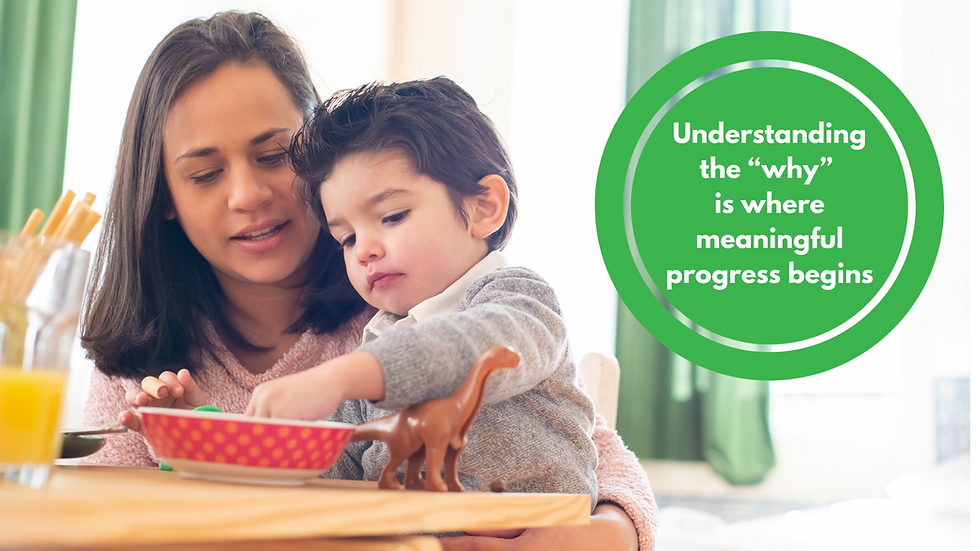
Lately, I've been thinking about the conversations happening around demand avoidance, particularly when children become distressed by expectations that adults might consider relatively ordinary: sitting at the table for a meal, transitioning to a new activity, participating in a routine, or engaging in a therapeutic task.
These conversations raise important questions for pediatric feeding therapists and other professionals who work with children.
What does it mean to be responsive to a child's needs? When does following a child's lead support development, and when might a child need something different from what they are currently able or willing to do? How do we respect a child's autonomy while still recognizing our responsibilities as adults?
These questions are particularly relevant in pediatric feeding therapy, where a child's responses may reflect sensory or physiological differences, difficulty with regulation, limited experience, previous negative experiences, anxiety, challenges with communication or comprehension, or a combination of factors.
Yet I sometimes see these conversations reduced to an overly simplistic choice: either we follow the child's lead and avoid demands, or we impose adult expectations and risk overriding the child's autonomy.
I don't think we have to choose between those positions.
Responsive does not mean permissive. Child-centered does not necessarily mean exclusively child-led. And supporting autonomy does not mean withdrawing adult guidance or responsibility.
To understand why, we need to look more closely at autonomy, relationships, and the concept of shared control.
First, a child's response is information, not a complete explanation
When a child resists a demand, avoids a task, leaves the table, refuses a food, or becomes distressed during an interaction, we have learned something important: something about that experience is not working for that child at that moment.
But the response itself doesn't tell us everything we need to know.
Why is the child responding this way? What might the child be communicating? What experiences have shaped this response? What demands are being placed on the child, and how are those demands being experienced? What skills, support, accommodations, or environmental changes might be needed?
And perhaps just as importantly, what are we actually trying to accomplish?
In pediatric feeding, a child who resists sitting at the table might be communicating discomfort with the seating arrangement, difficulty maintaining a stable position, sensory overload, fear associated with previous mealtime experiences, a need for movement, or distress about what typically happens once they sit down.
Alternatively, the child may have had few opportunities to develop the skills or routines associated with participating in family meals.These possibilities call for different responses.
If we assume that all resistance reflects an intolerable demand, we may overlook an opportunity to understand the underlying difficulty and provide meaningful support. If we assume that resistance is simply a behavior to overcome, we may overlook distress, unmet needs, or the impact of previous experiences.
The child's response should inform our clinical reasoning. It should not replace it.
Our responsibility is to understand the child and the context well enough to determine what that response means for our next steps.
Autonomy is not the same as independence
One of the most important distinctions in these conversations is the difference between autonomy and independence. In everyday language, we often use these terms interchangeably. But they are not the same. Independence generally refers to doing something without assistance from another person. Autonomy concerns agency and self-determination: having a meaningful role in one's actions and experiences.
A child can be autonomous while depending on adults for support. A child can express preferences, communicate discomfort, participate in decisions, and develop a sense of agency without being expected to manage every aspect of an experience independently.
This distinction is central to Self-Determination Theory, developed by Edward Deci and Richard Ryan. Their work identifies autonomy, competence, and relatedness as fundamental psychological needs and explores how social environments can support or undermine motivation and well-being (Ryan & Deci, 2000, 2017).
Autonomy does not require detachment from other people. Nor does it mean that a child must have complete control over every decision. This becomes more clear when we consider the concept of relational autonomy. Dove and colleagues (2017) challenge individualistic understandings of autonomy that treat self-determination primarily as an individual's independence from others. A relational perspective recognizes that our relationships and social environments influence our ability to exercise agency and develop our capacity for self-determination.
In other words, autonomy develops within relationships.
For children, this matters enormously. Their capacity to understand themselves, communicate their needs, navigate challenges, and participate in decisions develops over time and within the context of relationships with caregivers and other supportive adults.
We do not support autonomy only by stepping back. We also support it through how we show up.
Our responsiveness, our willingness to understand a child's experience, our recognition of their communication, and the opportunities we create for meaningful participation can all matter. This does not mean that every adult decision must be negotiable. It means that the way adults exercise responsibility can either support or constrain a child's developing agency.
What does shared control actually mean?
In my teaching, I use the concept of shared control to help therapists think about the relationship between a child's developing autonomy and the adult's ongoing responsibilities.
Shared control is not a formula for dividing decisions equally between a child and an adult. It is not a rule that the child gets to choose everything, and it is not a softer way of getting a child to comply with adult expectations. It is a way of thinking about the dynamic, bidirectional relationship between a child and the adults who care for them.
The child's communication, preferences, capacities, and responses influence the interaction. The adult's understanding, decisions, and actions influence the child's experience and opportunities for development.
Both matter.
The adult remains responsible for providing care, establishing appropriate boundaries, considering safety, and making decisions that fall within the adult's role. At the same time, the adult must recognize the child as an individual whose experiences and developing agency deserve meaningful consideration. Shared control requires us to hold these responsibilities together rather than assuming that honoring one necessarily means abandoning the other.
Shared control is relational, not simply transactional
It can be tempting to think about shared control as a question of who gets to make which decision.
In feeding, for example, we might ask whether the adult or child should decide what food is offered, where eating takes place, or how much the child eats. Those practical questions matter, and established feeding approaches such as Ellyn Satter's Division of Responsibility in Feeding provide one way of thinking about the distribution of responsibilities during meals.
But the broader developmental principle I am describing extends beyond assigning decisions to adults or children. It asks us to consider how the relationship itself supports the child's developing capacity for self-determination.
Can the child communicate a need without that communication being dismissed? Can the adult maintain an appropriate expectation while remaining curious about the child's experience? Can the adult adapt an approach when it is not working without interpreting adaptation as failure? Can the child experience both meaningful agency and the security of knowing that an adult remains engaged and responsible?
These are relational questions, not simply questions about who is in charge.
Attachment theory offers a complementary perspective. Supportive caregiving relationships can provide a secure base from which children explore and a safe haven to which they can turn when distressed. Connection and exploration are not opposing goals. Children need opportunities to develop their capacities, and they also need relationships in which support remains available.
This does not mean that every difficulty is caused by a relationship or that responsive caregiving can eliminate every challenge. Children have individual developmental, physiological, sensory, and environmental needs. However, the relational context in which we respond to those needs matters.
Supporting a child's autonomy does not require us to withdraw connection. Maintaining connection does not require us to control the child.
Shared control helps us consider how both can be supported.
Responsive is not the same as permissive
The distinction between responsiveness and permissiveness is important here.
Responsiveness involves noticing and attempting to understand a child's experience, interpreting communication in context, and adjusting our responses as appropriate.
Permissiveness, as the term is used in parenting-style research, generally describes warmth and responsiveness with relatively little demandingness or structure.
Authoritative parenting, by contrast, combines responsiveness with appropriate expectations and structure. These parenting categories were developed to describe broad patterns of parenting; they should not be treated as direct prescriptions for feeding therapy. Nevertheless, the distinction can help clarify the issue.
A responsive adult can maintain expectations. A responsive adult can establish boundaries. A responsive adult can recognize that a child is struggling and still consider whether there is a meaningful developmental goal worth supporting.
The critical question is not whether an expectation exists. It is whether that expectation is appropriate, how it is being implemented, what the child needs to participate successfully, and whether the adult is willing to reconsider the approach in light of the child's response.
For example, a therapist may have a legitimate reason to work toward improved positioning, participation in a family routine, or increased access to shared mealtime experiences. But that does not automatically make a conventional chair, a particular table arrangement, or a predetermined duration of sitting necessary.
We must distinguish the goal from the method.
If a child needs stable positioning to participate comfortably and safely, the goal may be to identify seating and support that meet the child's needs. If the goal is participation in family meals, we need to consider what participation can look like for that child and family. If sitting at the table has become associated with distress, we need to understand why before deciding what to do next.
We should not assume that the adult's preferred method is the only route to a meaningful outcome. Nor should we assume that any adult expectation is inappropriate simply because the child resists it.
The task is to reason through the situation, not to default automatically to either adult control or child control.
Demand avoidance requires curiosity, not a predetermined answer
The term demand avoidance can describe experiences that are important to understand. For some children, everyday expectations may be associated with substantial anxiety, distress, or a perceived loss of autonomy.
However, the label does not tell us everything about an individual child's experience, and it should not become a shortcut that replaces careful assessment. Research on pathological demand avoidance (PDA) has highlighted substantial variation in how the construct is defined and studied, as well as limitations in the evidence base. A systematic review by Kildahl and colleagues (2021) concluded that the available literature was heterogeneous and insufficient to establish PDA as a distinct disorder or stable subtype of autism. This uncertainty does not invalidate children's experiences of distress or demand avoidance. It reinforces the importance of understanding each child rather than assuming that one label provides a complete explanation or dictates a particular intervention.
When a child avoids a demand, we might consider:
Is the task physically uncomfortable, physiologically challenging, or beyond the child's current capacity?
Is the child experiencing sensory overload, anxiety, uncertainty, or difficulty with regulation?
Does the child understand what is being asked, and do they have the skills and support needed to participate?
Have previous experiences made this activity unpredictable, threatening, or associated with loss of control?
Is the expectation meaningful and necessary, or are we attached to a particular method because it is familiar?
What is the adult communicating through the way the expectation is presented?
What changes might allow the child to participate with greater safety, agency, and success?
These questions do not guarantee an easy answer. They help us avoid imposing an explanation before we understand the child. They also remind us that two children who exhibit similar avoidance may need very different support. One child may need environmental accommodations. Another may need help developing a skill. Another may need a slower, more predictable approach because of previous negative experiences. Another may be communicating that the proposed goal or method is not appropriate.
Our job is to figure out what is happening and respond accordingly.
When a child resists sitting at the table
Let's return to a familiar example.
A child consistently refuses to sit at the table for meals. The adults are concerned about participation in family meals, and a therapist identifies sitting at the table as a treatment goal. What should happen next?
A compliance-oriented approach might focus on getting the child to sit, perhaps through reinforcement, repeated prompting, or a behavioral plan.
An exclusively child-led interpretation might conclude that the child should never be expected to sit at the table because the child is communicating that they do not want to.
Neither response adequately addresses all the questions we need to ask.
A shared-control approach begins by examining the goal and the child's experience.
First, clarify the purpose.
Why is sitting at the table important? Is the goal related to positioning, access to food, participation in family routines, safety, social connection, or something else? Is sitting in a conventional chair essential to that goal, or is it simply the method adults have chosen?
Second, understand the child's response.
What happens when the child is asked to sit? What does the child communicate? Are there physical, sensory, emotional, developmental, or relational factors that might help explain the difficulty? What has the child learned from previous mealtime experiences?
Third, consider the adult's responsibility.
What does the child need from the adults to participate safely and meaningfully? What boundaries or routines are appropriate for this family? What can the adults change, and what support might they need to make those changes?
Fourth, identify a meaningful next step.
Perhaps the child needs different seating, a more flexible arrangement, shorter periods of participation, a predictable routine, or a different way to be included in the family meal. Perhaps the adults need to address the child's distress before working toward a particular routine. Perhaps the original goal needs to be reconsidered.
The intervention may involve accommodation, skill development, changes to the environment, support for regulation, or some combination of these. It should not involve abandoning all consideration of participation simply because the child currently resists it.
The point is not to win a struggle over the chair. It is to understand what the child needs and determine how best to support the child and family.
Sometimes we accommodate. Sometimes we build capacity. Sometimes we stop.
One reason shared control is useful is that it allows us to consider different responses without treating any one of them as universally correct.
There are times when accommodation is the most appropriate response. If the environment creates an unnecessary barrier, changing the environment may be exactly what the child needs. There are times when we should help a child develop capacity. A child may benefit from supported opportunities to practice a skill, become familiar with an experience, or participate in an activity in a way that is manageable and meaningful.
And there are times when we need to pause, protect, or prioritize recovery. If an experience is causing significant distress, if the goal is not necessary, or if we do not yet understand what is happening, continuing to pursue the original goal may not be appropriate.
These options are not mutually exclusive. A child may need accommodations while developing new skills. A family may need to change a routine while a therapist investigates underlying difficulties. A goal may be appropriate in the long term but not at the present moment.
Shared control helps us remain responsive to the child while retaining our responsibility to think, assess, plan, and make informed decisions.
Importantly, building capacity is not synonymous with teaching compliance. We can help children develop skills and participate in experiences without making obedience the measure of progress.
Likewise, accommodation is not inherently avoidance, and pausing is not necessarily failure.
The question is whether our response fits the child's needs, the family's circumstances, and the actual purpose of the intervention.
What this means for pediatric feeding therapy
Feeding is particularly vulnerable to oversimplification because eating involves so many overlapping systems and experiences. A child's feeding difficulties may involve physiological or medical factors, oral-motor skills, sensory experiences, positioning, cognition, learning, communication, therapy history, regulation, relationships, family routines, and access to appropriate support. Often, numerous factors interact and overlap.
When we focus exclusively on a child's willingness to eat, we may overlook the reasons eating is difficult.
When we focus exclusively on sensory exploration or food acceptance, we may overlook functional, physiological, or oral-motor needs. And when we focus exclusively on avoiding demands, we may overlook opportunities to address barriers, develop skills, or help a family establish routines that support participation.
The reverse is also true. If we focus exclusively on achieving functional outcomes, we may overlook distress, autonomy, and the effects of previous experiences.
This is why I teach AEIOU: An Integrated Approach to Pediatric Feeding as a framework for clinical reasoning rather than a prescribed list of intervention strategies.
AEIOU gives therapists a way to think about why a child is experiencing feeding difficulties, what has happened in the past, what is happening now, and how to organize that understanding into an intervention plan.
It encourages us to consider the multiple factors influencing feeding rather than reducing a child's experience to a single explanation or modality.
Shared control fits within this broader way of thinking. It asks us to consider the child, the caregiver, and the interaction between them as we determine what support is appropriate.
We must understand what the child is communicating without assuming that we already know what it means. We must respect the child's developing autonomy without assuming that the child must determine every aspect of treatment. We must recognize our responsibilities as professionals without assuming that our preferred methods are necessarily the right ones.
And we must be willing to change our approach when our understanding changes.
The real question is not who gets control
When conversations about demand avoidance and autonomy become polarized, we can lose sight of what we are actually trying to accomplish.
We are not trying to establish whether the adult or the child should always be in control.
We are trying to understand the child, the context, the developmental needs, the relationship, and the purpose of the expectation. We are trying to distinguish between what is necessary and what is merely customary, between supporting capacity and demanding compliance, and between respecting a child's communication and assuming that the child's current response provides the entire answer.
Relational autonomy reminds us that children's agency develops within relationships. Self-Determination Theory helps explain why autonomy, competence, and relatedness matter. Attachment theory helps us consider how connection and security can support exploration and development.
Shared control brings these ideas into clinical reasoning by asking us to hold the child's developing agency and the adult's ongoing responsibility together.
This is not always simple. It requires observation, reflection, clinical knowledge, flexibility, and a willingness to question our own assumptions. It also requires us to recognize that a child's immediate response is only one part of a much larger picture.
We do not need to choose between respecting a child's autonomy and recognizing our responsibility as adults. We need to learn how to honor both.
That is the work of responsive practice.
And it is why being child-centered does not require us to be exclusively child-led.
References
Dove, E. S., Kelly, S. E., Lucivero, F., Machirori, M., Dheensa, S., & Prainsack, B. (2017). Beyond individualism: Is there a place for relational autonomy in clinical practice and research? Clinical Ethics, 12(3), 150–165. https://doi.org/10.1177/1477750917704156
Kildahl, A. N., Helverschou, S. B., Rysstad, A. L., Wigaard, E., Hellerud, J. M. A., Ludvigsen, L. B., & Howlin, P. (2021). Pathological demand avoidance in children and adolescents: A systematic review. Autism, 25(8), 2162–2176. https://doi.org/10.1177/13623613211034382
Larzelere, R. E., Morris, A. S., & Harrist, A. W. (Eds.). (2013). Authoritative parenting: Synthesizing nurturance and discipline for optimal child development. American Psychological Association. https://doi.org/10.1037/13948-000
Lohse, B., & Mitchell, D. C. (2021). Valid and Reliable Measure of Adherence to Satter Division of Responsibility in Feeding. Journal of nutrition education and behavior, 53(3), 211–222. https://doi.org/10.1016/j.jneb.2020.11.007
Ryan, R. M., & Deci, E. L. (2000). Self-determination theory and the facilitation of intrinsic motivation, social development, and well-being. American Psychologist, 55(1), 68–78. https://doi.org/10.1037/0003-066X.55.1.68
Ryan, R. M., & Deci, E. L. (2017). Self-determination theory: Basic psychological needs in motivation, development, and wellness. Guilford Press.
Satter E. M. (2014). Testing Satter's Division of Responsibility in Feeding in the context of restrictive snack-management practices. The American journal of clinical nutrition, 100(3), 986–987. https://doi.org/10.3945/ajcn.114.091512
Comments